Organic Clothing
Organic Denim
Organic denim is the hardest clothing claim to pin down. Plenty of jeans use organic cotton, but few are GOTS certified as finished garments, and even certified brands do not label every style. Check the specific pair for a GOTS statement, read the fiber blend, and treat "organic cotton denim" alone as a fiber claim.
What organic means here
We looked for jeans with a GOTS claim on the product and a seller listed in the GOTS public database. Two picks meet that. The third is certified to the Organic Content Standard, which is a different program, and is labeled as such. Stretch denim contains elastane, and we state the blend.
Look for
- A GOTS statement on the product page or sewn-in label for the exact style, with a certifier and number
- The fiber blend: rigid denim can be 100% cotton, stretch denim adds 1% to 3% elastane
- The seller's name in the GOTS public database, with denim pants in its entry
- Which standard a claim names: GOTS, or the Organic Content Standard (OCS)
Be wary of
- "Made with organic cotton" and no certifier, percentage or number
- A brand-level GOTS announcement used to imply that every pair is labeled
- Jeans blended with recycled conventional cotton and described as GOTS: the standard prohibits conventional cotton, recycled or not
- "Eco" or "sustainable" wash claims with no specifics
Products that carry the certification
We have not tested these products. Each one was checked against the brand’s own page and the certifier’s records. Product links may be affiliate links: if you buy through one we may earn a commission, at no extra cost to you. How we choose.
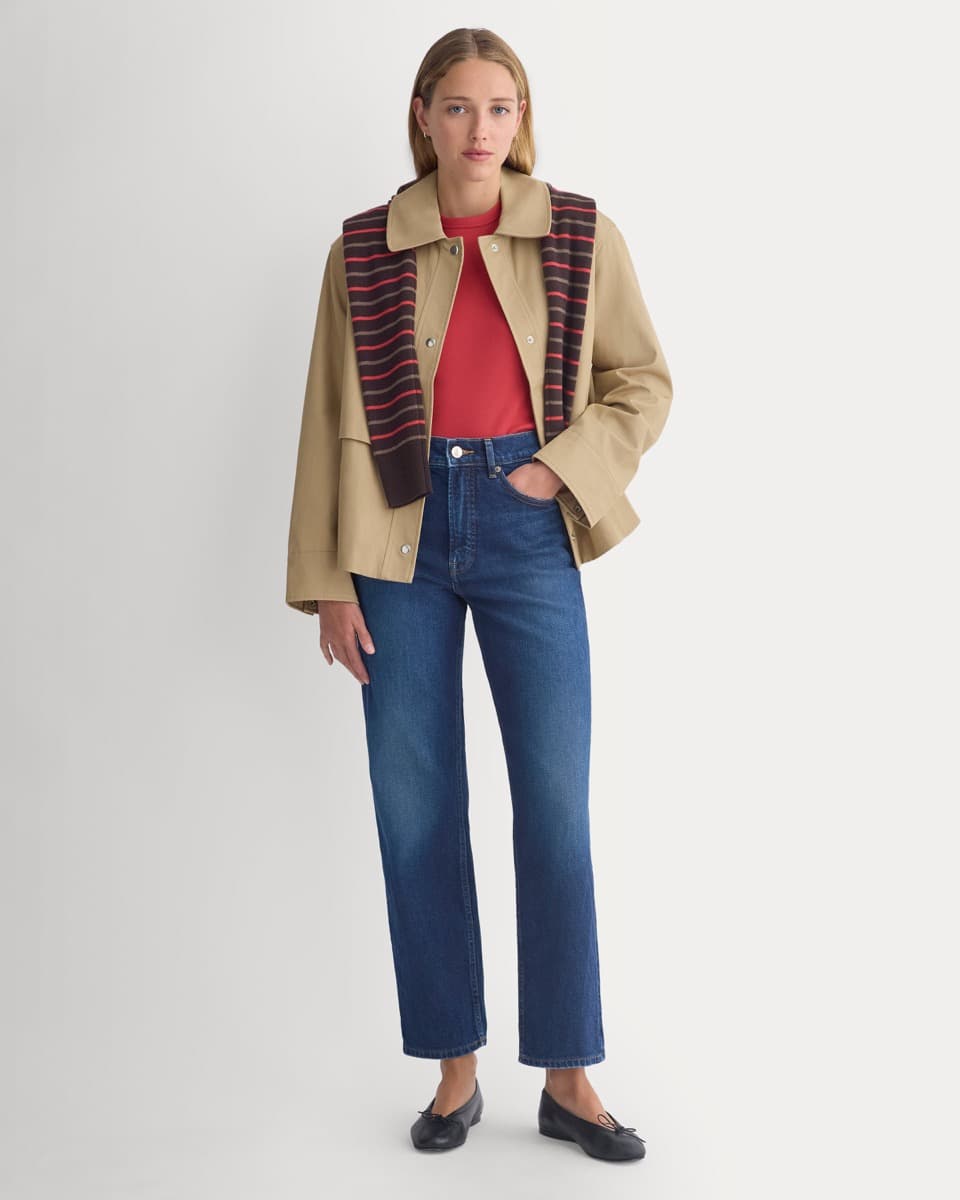
Photo: Everlane 1EverlaneOCS organic cotton, US brandThe Way-High Jean 2.0
- Organic Content Standard
The product page lists 98% organic cotton and 2% elastane and says the garment is made from certified organic cotton. Everlane states it uses the OCS 100 standard and logo on products containing at least 95% certified organic cotton.
Good to know: This is an Organic Content Standard claim, not GOTS. Everlane appears in the GOTS database with some denim in its entry, but this product page does not claim GOTS for this jean, so it does not meet the department's GOTS standard.
Checked against: everlane.com · global-standards.org
View at Everlaneeverlane.com
- 2KuyichiGOTS stated on the product page
Jim Regular Slim Mid Blue
The product page lists 99% certified organic cotton and 1% elastane, says the jean is produced in Pakistan and calls it "a Global Organic Textile Standard (GOTS) certified product". Kuyichi BV is in the GOTS database as a certified trader, with pants at this blend in its entry.
Good to know: Kuyichi is a Dutch brand, and the page lists delivery times for the Benelux and Germany only, so confirm shipping to the US. The page gives no licence number, and the database entry showed a certificate valid until November 25, 2026.
Checked against: kuyichi.com · global-standards.org
View at Kuyichikuyichi.com
- 3Nudie JeansRigid and stretch fits, US store
Men's Jeans
Nudie Jeans says it became fully GOTS-certified as a brand in January 2024, together with its value chain. Nudie Jeans Marketing AB is in the GOTS database, with men's and women's denim pants in its entry, including blends of 98% organic cotton and 2% elastane.
Good to know: Not every pair is labeled. The brand says it cannot retro-certify existing styles and that the label is rolling out with new drops. The product page we opened showed no GOTS statement, so check the sewn-in label.
Checked against: nudiejeans.com · global-standards.org
View at Nudie Jeansnudiejeans.com
Products with a photo are shown first; otherwise the order says nothing about quality. Certifications can lapse: check the certifier’s database before you buy.
Organic cotton denim versus GOTS certified jeans
Cotton is a crop, and the USDA regulates the word organic for the raw fiber. It has no processing rules for textiles. A pair of jeans can be woven from certified organic cotton and then dyed, washed and finished outside any organic standard. Denim finishing involves many steps, which is why a fiber claim alone tells you little about the finished pair.
GOTS certifies the finished textile. It requires at least 95% certified organic fiber for the "organic" grade and 70% for "made with organic materials", restricts chemical inputs in processing and includes social criteria. USDA policy lets GOTS clothing be sold as organic in the United States, without the USDA seal. Our guide on what organic means covers the legal side.
Brand certified does not mean every pair is labeled
GOTS says that for an end product to carry its label, every company in the process must be certified. Jeans pass through spinners, weavers, dye houses, sewing factories and laundries, so certifying a whole denim line takes time.
One brand on this page says so openly: it holds a GOTS certificate, but it cannot certify older styles after the fact, and labeled pairs arrive season by season. The practical rule is to check the individual product. A GOTS label shows the logo, the label grade, the certification body and a certification number.
| Claim on the jean | What it covers |
|---|---|
| GOTS organic, with a number | At least 95% organic fiber and a certified chain through processing |
| GOTS made with organic materials | At least 70% organic fiber, same chain rules |
| OCS | A separate standard named on the label, not GOTS |
| Organic cotton, no certifier | A fiber claim with nothing to look up |
Stretch, recycled cotton and hardware
Rigid denim can be all cotton. Stretch denim adds elastane, usually 1% to 3% in the jeans we checked. GOTS Version 8.0, released in 2026, allows up to 10% virgin synthetic fiber such as elastane, so a 98% organic cotton jean can still carry the "organic" grade.
Recycled cotton is different. The standard prohibits conventional cotton as an additional fiber, whether virgin or recycled. A jean that blends organic cotton with recycled conventional cotton cannot carry a GOTS label on that blend, so expect a different content claim. Buttons, rivets, zippers, thread and waist patches are accessories and follow separate rules from the fabric percentages.
How to check a pair before you buy
- 1
Read the product page
Look for a GOTS statement on the specific style and wash, not only on the brand's about page.
- 2
Search the database
Enter the company name or certification number in the GOTS certified suppliers database and confirm denim pants appear in the entry.
- 3
Check the date and the blend
Entries show how long the certificate is valid and list certified blends. Compare them with the fiber line on the jean.
- 4
Weigh other seals for what they are
OEKO-TEX Standard 100 means the finished item was tested for harmful substances. It is not an organic claim. Vague wash claims are covered in our guide to spotting greenwashing.
Questions people ask
Are all jeans from a GOTS certified brand GOTS certified?
No. A brand's certificate lets it sell certified products, but each product has to be made through a fully certified chain to carry the label. One denim brand listed here states that not every piece will carry the GOTS label right away because existing styles cannot be certified after the fact. Check the product page or the sewn-in label for the pair you want.
Can stretch jeans be GOTS certified?
Yes. GOTS Version 8.0 allows virgin synthetic fibers such as elastane up to 10% of the fiber content. A jean with 98% or 99% certified organic cotton and 1% or 2% elastane still clears the 95% threshold for the "organic" label grade. The blend must be stated on the fiber label either way.
What is the difference between GOTS and OCS on jeans?
They are separate standards, and a label should name which one applies. GOTS covers the organic fiber share and also sets rules for processing chemicals and working conditions through the supply chain. One retailer on this page says it uses OCS 100 on products containing at least 95% certified organic cotton. Read an OCS claim as a statement about the cotton content.
Can jeans carry the USDA Organic seal?
In practice, no. USDA policy says a textile may show the seal only if it is produced in full compliance with the National Organic Program rules, which have no textile processing standards. GOTS certified textiles may be sold as organic in the United States, but they may not show the seal or imply that the USDA certified the finished product.
Can jeans made with recycled cotton be GOTS certified?
Not if the recycled cotton is conventional. GOTS Version 8.0 lists conventional cotton, virgin or recycled, as a prohibited additional fiber. Recycled synthetic fibers are allowed up to 20%. So a jean that mixes organic cotton with ordinary recycled cotton cannot carry a GOTS label on that blend. Read the label to see which standard it names.
Sources
Each page was opened and read on October 11, 2026.
- USDA National Organic Program: Policy Memo 11-14, Labeling of Textiles That Contain Organic Ingredients
- Global Organic Textile Standard: GOTS Key Features
- Global Organic Textile Standard: Labelling
- Global Organic Textile Standard: GOTS Version 8.0 (PDF)
- Global Organic Textile Standard: Certified Suppliers Database
- OEKO-TEX: OEKO-TEX Standard 100
Keep reading
 ClothingOrganic T-Shirts & BasicsPlain tees from GOTS certified companies, with the fiber content and certifier number checked.
 ClothingOrganic LoungewearSweatpants and joggers from GOTS certified companies, with the fiber blend and certifier number checked.
 Baby & Kids ClothingOrganic Kids ClothingKids clothes from GOTS certified brands, and how to check that the garment, not just the cotton, is certified.