Organic Pets
Organic Cat Food
Cat food can be certified USDA Organic under the same rules as human food, and a certified food contains at least 95 percent organic ingredients. Few cat foods are. Check for the seal first, then for an AAFCO nutritional adequacy statement, because organic certification says nothing about whether a food is a complete diet for a cat.
What organic means here
This page accepts cat food that the brand states is certified USDA Organic as a whole product. A food that names organic ingredients without being certified as a whole can be listed with no certification shown and a caveat. Each pick says whether the brand page prints an AAFCO nutritional adequacy statement.
Look for
- The USDA Organic seal on the package, plus the name of the certifying agent
- An AAFCO nutritional adequacy statement for cats that names a life stage
- For kittens, a statement that covers growth or all life stages
- A full ingredient list on the brand's own product page
Be wary of
- "Made with organic chicken" on the front and no USDA Organic seal
- A product page that says "complete" without printing the AAFCO statement
- Toppers and broths for supplemental feeding sold next to complete foods
Products that carry the certification
We have not tested these products. Each one was checked against the brand’s own page and the certifier’s records. Product links may be affiliate links: if you buy through one we may earn a commission, at no extra cost to you. How we choose.
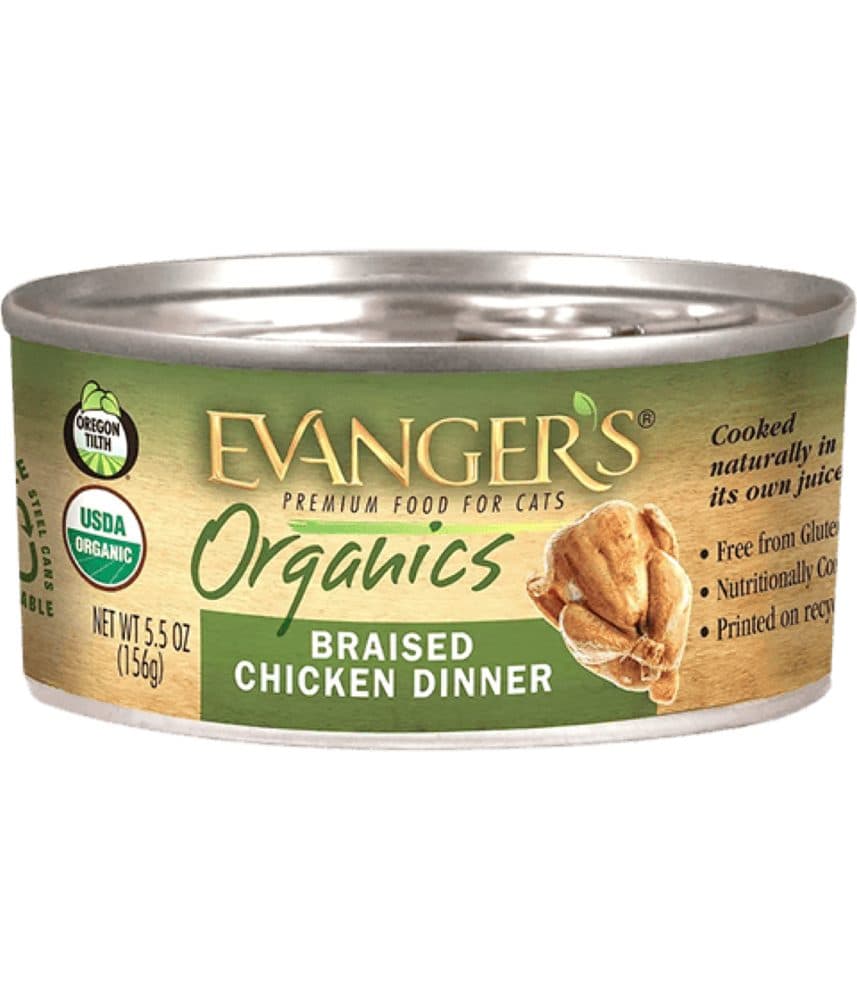
Photo: Evanger's 1Evanger'sCanned food, chicken and broth baseOrganic Braised Chicken Dinner for Cats
A canned cat food the product page calls a USDA Organic recipe. The ingredient list begins with organic chicken, organic chicken broth and organic chicken liver, followed by organic guar gum and added taurine, vitamins and minerals.
Good to know: Described as USDA Organic as a whole, with no certifier named. The page says it is balanced for all life stages but does not print an AAFCO nutritional adequacy statement, so read the can before relying on it as a sole diet.
Checked against: evangersdogfood.com
View at Evanger'sevangersdogfood.com
- 2Tender & TrueDry food, all life stages statement
Organic Chicken & Liver Recipe Dry Cat Food
A dry cat food the brand describes as a USDA certified organic recipe, with organic chicken as the first ingredient. The product page prints the AAFCO statement: formulated to meet the Cat Food Nutrient Profiles for all life stages.
Good to know: Certified organic as a whole. It is grain-free, and the page says grain free diets may not be suitable for all cats and to consult your veterinarian. No certifier is named on the page.
Checked against: tenderandtruepet.com
View at brand sitetenderandtruepet.com
- 3GatherOrganic chicken as an ingredient
Free Acres Recipe with Organic, Free-Run Chicken
A dry food for adult cats that the brand describes as made with organic ingredients, with certified organic free-run chicken as its single animal protein and organic peas. The page prints the AAFCO statement: formulated for maintenance.
Good to know: Not certified USDA Organic as a whole: the organic claim is for named ingredients, and no seal or certifier is shown. Listed as an example of that label tier. Grain-free, and for adult cats, not kittens.
Checked against: gatherpetfood.com
View at Gathergatherpetfood.com
Products with a photo are shown first; otherwise the order says nothing about quality. Certifications can lapse: check the certifier’s database before you buy.
How USDA Organic applies to cat food
USDA's organic labeling page says pet food may be certified to current production and handling standards and must follow the labeling rules for products certified under them. In plain terms, cat food is labeled like any other processed organic food: organic means at least 95 percent organic ingredients, and "made with organic" named ingredients means at least 70 percent, with no seal. Our guide on how to read a USDA Organic label covers all four tiers.
Rules written for pet food are in flux. USDA published a final rule, Market Development for Mushrooms and Pet Food, on December 23, 2024. USDA's summary says it covers composition and labeling requirements for organic pet food and the use of certain synthetic substances, including taurine. The compliance date is March 22, 2027.
On May 12, 2025, USDA proposed rescinding that rule. As its page read on October 11, 2026, organic operations must continue to comply unless the rule is rescinded. Taurine is the detail to notice on a cat food label: all three picks here list it as an added ingredient.
AAFCO "complete and balanced" for cats
The Association of American Feed Control Officials (AAFCO) publishes nutrient profiles for cat food. FDA explains that a cat food can be called complete and balanced only if it meets one of those profiles or passes a feeding trial that follows AAFCO procedures. A complete and balanced food is intended to be fed as a pet's sole diet.
The claim appears in the nutritional adequacy statement, which AAFCO says is usually on the back or side of the package in small print. It names a life stage: growth, maintenance, gestation and lactation, or all life stages. A kitten needs a food whose statement covers growth or all life stages.
AAFCO also notes that a product can be labeled for intermittent or supplemental feeding only. Those products are not complete diets, however good the ingredient list looks.
How to check a cat food's claims yourself
- 1
Find the seal
A certified organic cat food may show the USDA Organic seal. Without it, the food is not sold as an organic product, whatever the front says about one ingredient.
- 2
Find the certifier
Organic labels have to be reviewed and approved by a USDA-accredited certifying agent. Look for that agent's name on the package, then search the brand in USDA's Organic Integrity Database.
- 3
Read the adequacy statement
Look for the AAFCO wording and the life stage. If a brand's website paraphrases it, check the package itself.
- 4
Ask before you switch
Bring the label, or a photo of it, to your veterinarian before changing your cat's diet.
Grain-free cat food and the FDA's DCM reports
FDA's investigation into diet and dilated cardiomyopathy (DCM), announced in July 2018, centers on dogs. Of the 524 DCM reports FDA received between January 1, 2014 and April 30, 2019, 515 involved dogs and 9 involved cats. Many of the reported foods were labeled grain-free.
On December 23, 2022, FDA said it does not intend to release further public updates until there is meaningful new scientific information, and that the report numbers alone do not establish a causal relationship. Two of the picks above are grain-free. That is a label fact to raise with your veterinarian, the same as on our organic dog food page.
Questions people ask
Is there such a thing as certified organic cat food?
Yes, though the choice is small. USDA says pet food may be certified to its current organic production and handling standards. A certified cat food can carry the USDA Organic seal, and its label has to be approved by a USDA-accredited certifying agent. Many cat foods that mention organic only use an organic ingredient or two, which is a different and weaker claim.
Does organic cat food have everything my cat needs?
Not automatically. Organic certification covers how ingredients were produced. Whether the food is a full diet is a separate claim, made in the AAFCO nutritional adequacy statement. FDA says complete and balanced can be used only when a food meets an AAFCO nutrient profile or passes a feeding trial under AAFCO procedures. Check the life stage named in the statement.
Why is taurine added to organic cat food?
Taurine appears in the ingredient lists of all three cat foods on this page. USDA's summary of its December 2024 pet food rule says the rule addresses the use of certain synthetic substances, including taurine, in organic pet food. We do not give nutrition advice. If you have questions about taurine in your cat's diet, ask your veterinarian.
Should I switch my cat to organic food?
That is your decision and your veterinarian's. Organic is a production standard, and we make no health claims for it. Cats can be particular about food, and some have medical needs that limit their options. Talk to your veterinarian before changing your cat's diet, and bring the label so they can read the adequacy statement and the ingredient list.
Sources
Each page was opened and read on October 11, 2026.
- USDA Agricultural Marketing Service: Labeling Organic Products
- USDA Agricultural Marketing Service: National Organic Program, Market Development for Mushrooms and Pet Food
- USDA Agricultural Marketing Service: Rescinding National Organic Program; Market Development for Mushrooms and Pet Food
- FDA: "Complete and Balanced" Pet Food
- AAFCO: Understanding Pet Food, Reading Labels
- FDA: Investigation into Potential Link between Certain Diets and Canine Dilated Cardiomyopathy
- USDA National Organic Program: Organic Integrity Database
Keep reading
 PetsOrganic Dog FoodTwo label checks: the USDA Organic seal for how it was grown, the AAFCO statement for whether it is a full diet.
 PetsNatural Cat LitterCat litter is not certified organic. Compare plant-based litters on what they are made of and what is added.
 Food & PantryOrganic Meat & PoultryWhat USDA Organic requires for beef, pork and poultry, and how it differs from natural, free-range and grass-fed.